Today we start discussing Toni Morrison's novel The Bluest Eye in class.
Let's take a look at the Spark Notes guide to this novel:
http://www.sparknotes.com/lit/bluesteye/
It can be a good place to start if you're confused by the novel. But, it can also be limiting if you read only summaries and not the novel itself. You'll miss the artistry of the novel and the fullness of the story. And, while the analysis of the novel can be helpful, it also presents only one view of a certain passage. So use such resources thoughtfully and carefully.
Now, for some photos of Shirley Temple, that supposed icon of American girlhood, whose image entrances Pecola:
http://www.shirleytemple.com/
And a video of Shirley and Mr. Bojangles.
And some examples from the Dick and Jane readers:
http://faculty.valpo.edu/bflak/dickjane/spot.html
http://en.wikipedia.org/wiki/Dick_and_Jane
Monday, March 30, 2009

Monday, March 9, 2009
Ecofeminist Approaches to Ruth Ozeki's *All Over Creation*
 Lady Lilith, painting by Dante Gabriel Rossetti, 1863
Ruth Ozeki’s All Over Creation and Ecofeminism
What is Ecofeminism?
Ecofeminism is the merging of ecocriticism (critical approaches that focus on environmental issues) and feminism (critical approaches that focus on women). There are many versions of ecofeminism, and each one has a slightly different twist on the subject.
Here are a few key Ecofeminist ideas:
* Much Western thought, especially Enlightenment thought, but also reaching back to Aristotle, emphasizes dualities like culture/nature, man/woman, reason/emotion, mind/body, God/man. In these dualities, the first term is privileged and then the second one is degraded. As you can see from the examples above, this leaves nature and women in a secondary position.
* The Enlightenment emphasized a Great Chain of Being, in which a hierarchy was established, with God at the top, and lesser beings falling in line afterwards.
* The Enlightenment also traded in earlier conceptions of nature as an organism to nature as a machine. This was, after all, the Age of Reason and the dawn of the Industrial Revolution when order and mechanization were revered.
* Ecofeminist scholars are reacting to the various dualities, hierarchies, and privileging of some kinds of knowing that persist long after the Enlightenment.
* Ecofeminist thought is sometimes in line with Deep Ecology, which is the belief that everything is interconnected and equal, that a change in one minute part of the ecosystem causes ripple effects elsewhere.
* Ecofeminists sometimes celebrate the identification of women with nature, and other times they distance themselves from this equation.
* Ecofeminism sees the oppression and/or degradation of nature and women to be intimately related.
Here are a few quotes from Ecofeminist scholars that illustrate these ideas:
Carol Adams: “Ecofeminism stresses relationship, not solely because it has been women’s domain, but because it is a more viable ethical framework than autonomy for transforming structures that are environmentally destructive.”
Ynestra King: “Capitalism, the preeminent culture and economics of self-interest, is homogenizing cultures and simplifying life on earth by disrupting naturally complex balances within the ecosystem...[in Western culture there is] a deep ambivalence about life itself, our own fertility and that of nonhuman nature, and a terrible confusion about our place in nature.”
Carolyn Merchant: “The image of the earth as a living organism and nurturing mother had served as a cultural constraint restricting the actions of human beings [...] As long as the earth was considered to be alive and sensitive, it could be considered a breach of human ethical behavior to carry out destructive acts against it.”
Winnie Tomm: “The view of both women and nature as raw material to be used according to the desires of others underpins exploitation of both.”
Susan Bordo: “By Descartes’s brilliant stroke, nature becamse definedby its lack of affiliation with divinity, with spirit. All that which is God-like or spiritual--freedom, will, and sentience--belong entirely and exclusively to res cognitans. All else--the earth, the heavens, animals, the human body--is merely mechanically interacting matter.”
Why use Ecofeminism to interpret literature?
Ecofeminism can help us understand how issues of nature and women are interwoven, and it can give us a new perspective on reading literature.
How does Ecofeminism apply to All Over Creation?
Ozeki’s novel is filled with symbols and images of nature and women--let’s make our own list! These symbols bring a greater depth to the novel than just an engaging plot.
Life, birth, death, passion are all prominent themes that are explored through female characters, the male characters who try to control them, and the children--both literal, figurative, and absent--that fill their lives.
Ozeki seems to be asking some big questions about these themes--what is the value of life? Who has power over life? Are some lives worth more than others? That she uses potatoes and issues of genetic modification to frame these questions places her novel squarely in the eco-lit camp. And we can make the case for this novel as a feminist statement as well--how many of the main characters are women? Who sets chains of events in motion?
Now, what particular characters, symbols, events, and/or places seem to lend themselves to an ecofeminist reading? Let’s test some Ecofeminist readings of the novel!
Here's a link to info and paintings of the Hindu Goddess Kali, who we see in Duncan's office towards the end of the reading. She's a great ecofeminist and multi-cultural symbol in the novel.
http://www.sanatansociety.org/hindu_gods_and_goddesses/kali.htm
What is Ecofeminism?
Ecofeminism is the merging of ecocriticism (critical approaches that focus on environmental issues) and feminism (critical approaches that focus on women). There are many versions of ecofeminism, and each one has a slightly different twist on the subject.
Here are a few key Ecofeminist ideas:
* Much Western thought, especially Enlightenment thought, but also reaching back to Aristotle, emphasizes dualities like culture/nature, man/woman, reason/emotion, mind/body, God/man. In these dualities, the first term is privileged and then the second one is degraded. As you can see from the examples above, this leaves nature and women in a secondary position.
* The Enlightenment emphasized a Great Chain of Being, in which a hierarchy was established, with God at the top, and lesser beings falling in line afterwards.
* The Enlightenment also traded in earlier conceptions of nature as an organism to nature as a machine. This was, after all, the Age of Reason and the dawn of the Industrial Revolution when order and mechanization were revered.
* Ecofeminist scholars are reacting to the various dualities, hierarchies, and privileging of some kinds of knowing that persist long after the Enlightenment.
* Ecofeminist thought is sometimes in line with Deep Ecology, which is the belief that everything is interconnected and equal, that a change in one minute part of the ecosystem causes ripple effects elsewhere.
* Ecofeminists sometimes celebrate the identification of women with nature, and other times they distance themselves from this equation.
* Ecofeminism sees the oppression and/or degradation of nature and women to be intimately related.
Here are a few quotes from Ecofeminist scholars that illustrate these ideas:
Carol Adams: “Ecofeminism stresses relationship, not solely because it has been women’s domain, but because it is a more viable ethical framework than autonomy for transforming structures that are environmentally destructive.”
Ynestra King: “Capitalism, the preeminent culture and economics of self-interest, is homogenizing cultures and simplifying life on earth by disrupting naturally complex balances within the ecosystem...[in Western culture there is] a deep ambivalence about life itself, our own fertility and that of nonhuman nature, and a terrible confusion about our place in nature.”
Carolyn Merchant: “The image of the earth as a living organism and nurturing mother had served as a cultural constraint restricting the actions of human beings [...] As long as the earth was considered to be alive and sensitive, it could be considered a breach of human ethical behavior to carry out destructive acts against it.”
Winnie Tomm: “The view of both women and nature as raw material to be used according to the desires of others underpins exploitation of both.”
Susan Bordo: “By Descartes’s brilliant stroke, nature becamse definedby its lack of affiliation with divinity, with spirit. All that which is God-like or spiritual--freedom, will, and sentience--belong entirely and exclusively to res cognitans. All else--the earth, the heavens, animals, the human body--is merely mechanically interacting matter.”
Why use Ecofeminism to interpret literature?
Ecofeminism can help us understand how issues of nature and women are interwoven, and it can give us a new perspective on reading literature.
How does Ecofeminism apply to All Over Creation?
Ozeki’s novel is filled with symbols and images of nature and women--let’s make our own list! These symbols bring a greater depth to the novel than just an engaging plot.
Life, birth, death, passion are all prominent themes that are explored through female characters, the male characters who try to control them, and the children--both literal, figurative, and absent--that fill their lives.
Ozeki seems to be asking some big questions about these themes--what is the value of life? Who has power over life? Are some lives worth more than others? That she uses potatoes and issues of genetic modification to frame these questions places her novel squarely in the eco-lit camp. And we can make the case for this novel as a feminist statement as well--how many of the main characters are women? Who sets chains of events in motion?
Now, what particular characters, symbols, events, and/or places seem to lend themselves to an ecofeminist reading? Let’s test some Ecofeminist readings of the novel!
Here's a link to info and paintings of the Hindu Goddess Kali, who we see in Duncan's office towards the end of the reading. She's a great ecofeminist and multi-cultural symbol in the novel.
http://www.sanatansociety.org/hindu_gods_and_goddesses/kali.htm
The painting at the top of this post is of Lilith, a powerful and mythical woman, said to be a lust-inducing demon, a chil killer, and, by some accounts, Adam's first (and rejected) wife.
Wednesday, March 4, 2009
eng 278: mla citation example: article from database
Here is the template for an article found using a library database:
Author's Last Name, First Name. "Article Title." Periodical Title volume number.issue number (Publication Date): Page number-page number. Database Name. Service Name. Library Name, City, State. Date of access.
And here's an example with the information filled in:
Smith, Caroline J. "Living the Life of a Domestic Goddess: Chick Lit's Response to Domestic Advice Manuals." Women's Studies: An Interdisciplinary Journal 34.8 (Dec. 2005): 671-99. MLA International Database. EBSCO. University of Wisconsin-Manitowoc, Manitowoc, WI. 4 Mar. 2009.
***note: the formatting is not working. you should use reverse indentation--that is, every line after the first one should be tabbed in.***
Monday, March 2, 2009
eng 278: all over creation
Ruth Ozeki's novel All Over Creation (2003) responds to cultural concerns about agriculture and the food chain.
See Michael Pollan's article "Playing God in the Garden," which Ozeki alludes to on page 85. Pollan is regarded as the food politics journalist of our time, raising consciousness about agricultural practices.
Towards the end of today's reading, we learn of the NuLife Enhanced potatoes--genetically modified and capable of repelling pests without many inputs. The NuLife is based on the New Leaf potato, introduced by Monsanto in the 1990s. See this graphic on Monsanto's website for a visual representation of how they see the potato working. For a little history on these potatoes, see this website from Cornell University.
And, to see a real collection of seed savers, look at the Seed Savers Exchange website and catalog.
See Michael Pollan's article "Playing God in the Garden," which Ozeki alludes to on page 85. Pollan is regarded as the food politics journalist of our time, raising consciousness about agricultural practices.
Towards the end of today's reading, we learn of the NuLife Enhanced potatoes--genetically modified and capable of repelling pests without many inputs. The NuLife is based on the New Leaf potato, introduced by Monsanto in the 1990s. See this graphic on Monsanto's website for a visual representation of how they see the potato working. For a little history on these potatoes, see this website from Cornell University.
And, to see a real collection of seed savers, look at the Seed Savers Exchange website and catalog.
Sunday, February 15, 2009
Today we begin reading Laura Esquivel's novel Like Water for Chocolate.
First, we'll explore how the novel is framed--from the epigraph, to the seasonal/chronological organization, to the use of recipes, and chapters, Esquivel provides more than one frame for her story. Additionally, I want to explore the novel as an example of a romance, using Pamela Regis' eight essential elements of romance novels.
Consider the setting of the story: during the Mexican revolution. How does Esquivel use this setting to express other themes in the novel? What other revolutions do we see?
Finally, we need to explore how the novel uses magic realism.
Wednesday, February 11, 2009
eng 278: hema and kaushik
Today we finish reading Jhumpa Lahiri's short story collection Unaccustomed Earth. As we discussed on Monday, the last three stories are connected, chronicling the lives of Hema and Kaushik.
Monday we discussed the importance of Point of View. Here, Hema and Kaushik each have their own story, "Once in a Lifetime" and "Year's End," respectively. The third and final story, "Going Ashore," reverts back to our omniscient narrator--this time giving us a peek into each of our characters minds--and then back to Hema's first person narration at the conclusion. What is the significance of this switch in Point of View? What kinds of intimacy and distance does Lahiri create through the narration?
I also want us to situate Hema and Kaushik's story within the whole collection--how does their story fit in with the themes and issues we've read? Can we begin to draw some conclusions about post-colonial identity, about love and marriage, and cultural intersections, about place, home? Have all of our characters built their lives on "unaccustomed earth"?
Also, to best understand these stories, it helps to look at several key symbols:
water/swimming/drowning/tsunami
photography
Wednesday, February 4, 2009
eng 278: jhumpa lahiri, "only goodness," van eyck, and post-colonialism
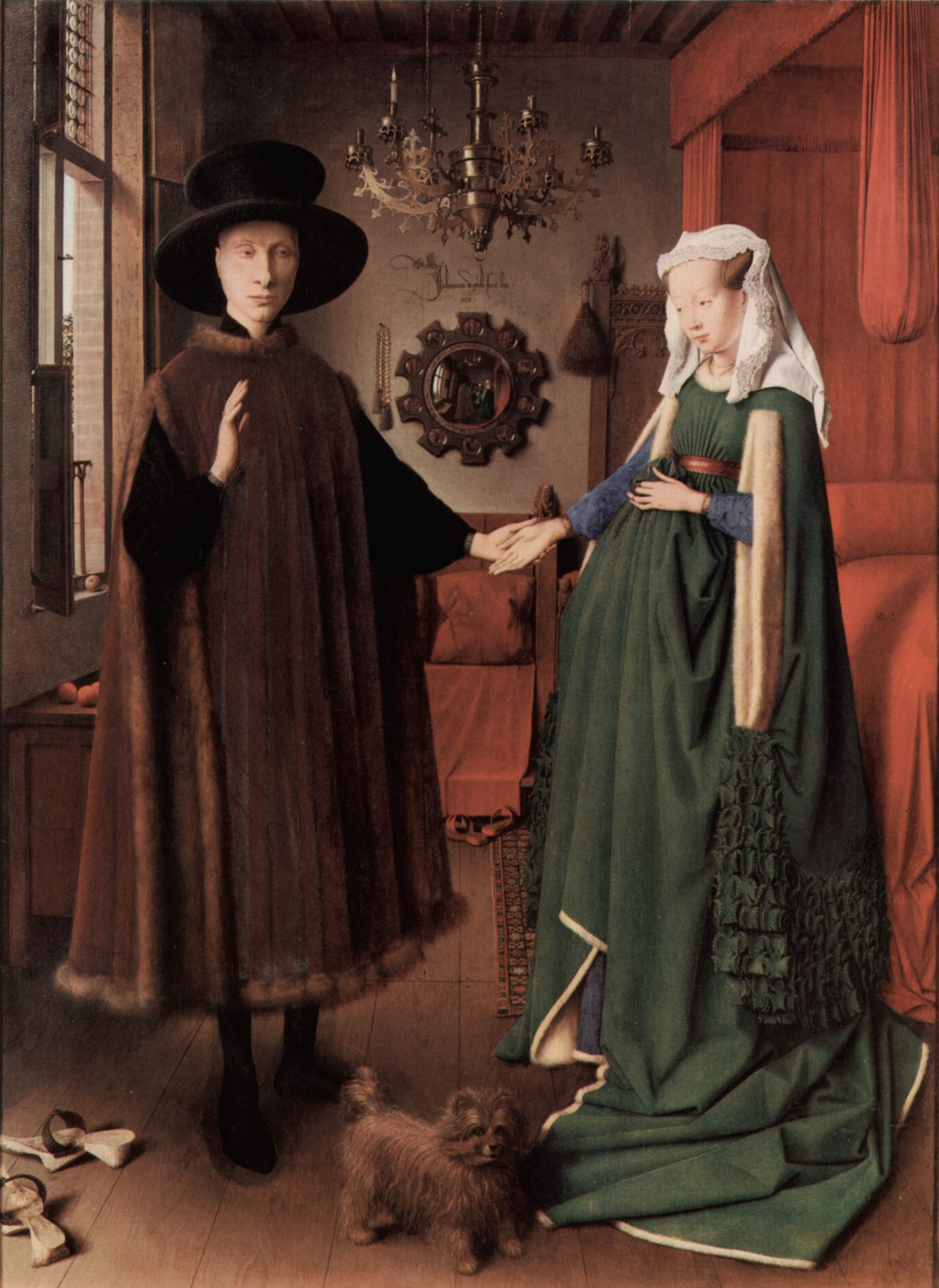 The Arnolfini Portrait, painting by Jan van Eyck, 1434. painting is in the National Gallery, London. image courtesy of wikipedia.
 In today's story, "Only Goodness," Sudha and Roger meet while looking at this painting. Roger guides Sudha's exploration of the painting, helping her notice the subtle layers within the scene, including the figures reflected in the mirror. What story do you create from this painting? Can you fit Sudha and her family into the world depicted by Van Eyck?
Today we'll also discuss the movement in the story--the trifecta of London, India, and New England marks out a certain post-colonial space that the Bengali families in Lahiri's stories inhabit.
Subscribe to:
Posts (Atom)