http://www.ted.com/talks/cary_fowler_one_seed_at_a_time_protecting_the_future_of_food.html
http://www.ted.com/talks/louise_fresco_on_feeding_the_whole_world.html
http://www.ted.com/talks/mark_bittman_on_what_s_wrong_with_what_we_eat.html
Thursday, March 29, 2012

Thursday, February 16, 2012
int 290: born this way?: 20th and 21st century American feminisms and popular culture
This blog post captures the heart of my INT 290 presentation on 20th and 21st century American feminisms and popular culture. This presentation will include several videos, that are posted in separate blog entries. Students will also be doing interactive interpretive activities and freewrites throughout the class to engage with the material.
What is Feminism? Why Feminisms?
Take a few minutes to jot down your definition of feminism. If you have no idea, please say so!
How Others Have Defined Feminism, For Better or For Worse
"I myself have never been able to find out what feminism is; I only know that people call me a feminist whenever I express sentiments that differentiate me from a doormat or a prostitute." Rebecca West, 20th Century Author
"The feminist agenda is not about equal rights for women. It is about a socialist, anti-family political movement that encourages women to leave their husbands, kill their children, practice witchcraft, destroy capitalism and become lesbians." Pat Robertson, Christian Televangelist
"Feminist politics aims to end domination, to free us to be who we are - to live lives where we love justice, where we can live in peace. Feminism is for everybody." bell hooks, feminist philosopher
"One is not born, but rather becomes, a woman." Simone de Beauvoir, French philosopher
"I'm not a feminist, but... I appreciate the right to help choose my government representatives. I enjoy the option of wearing pants or shorts if I want. I'm pleased that I was allowed to learn to read and write. It can be very convenient to control how many babies I want to have. It's awfully useful to be able to open a bank account and own property in my name. I like knowing that my husband or boyfriend cannot legally beat me. It's really swell to keep the money that I earn." poster from One Angry Girl
What Feminism Really Is
Equality for all persons, regardless of sex or gender.
The Sex-Gender Distinction
Simone de Beauvoir's famous quote from her book The Second Sex, “One is not born but becomes a woman” speaks to the difference between sex (biology) and gender (culture).
In what ways is this distinction complicated?!?
Feminism's Relationship to Patriarchy
We live in a patriarchal society--that is, a society structured around an unequal sexual division of power dominated by men.
My favorite way of understanding patriarchy is through author and scholar Allan Johnson's definition:
"A society is patriarchal to the degree that it promotes male privilege by being male dominated, male identified, and male centered. It is also organized around an obsession with control and involves as one of its key aspects the oppression of women" (Johnson 5).
Johnson, Allan. The Gender Knot: Unraveling Our Patriarchal Legacy. Philadelphia: Temple UP, 1997.
What examples do we have that patriarchy still exists?
Representation in US Congress 2011:
House:
Men 357
Women 78
Senate:
Men 33
Women 17
And how does Wisconsin represent? Since 1917, Wisconsin has had 2 female House members (2005, 1999) and 0 female Senators.
(Women in Congress)
Representation in Fortune 500 CEOs:
Currently, 12 F500 Companies are run by women.
(Fortune 500)
What are some other ways that we see Patriarchy at work?
Current Events:
Contraception Hearing, February 16, 2012

Photo from Fox News
How Has Feminism Made a Difference in America?
Many feminists chronicle the history of the movement in waves--movements that ebb and flow and overlap.
First Wave: Focus on voting rights, from the Seneca Falls Convention in 1848 and the creation of the Declaration of Sentiments to the right to vote in 1920.

Second Wave: Focus on political issues, including women in the workplace, equitable relationships, and reproductive rights. Two key phrases: "the personal is political" and "the problem with no name."

Third Wave: 1990s-present. Focus on multiculturalism, individualism, popular culture, body issues. Sex positive. Choice feminism. Men included more explicitly. Use of social media to share feminist messages: feministing.com and jezebel.com
Postfeminism: rejects women as victims in several key ways, such as questioning date rape and not questioning pornography or sex work. tends to be heterosexist. a backlash to second wave feminism, critiquing feminism as a monolithic movement the prescribes personal behavior. Camille Paglia.
(Waves of Feminism)
Popular Music and Feminism:
Madonna: debut album, Madonna, 1983. Feminist scholar bell hooks on Madonna: "What some of us like about her is the way she deconstructs the myth of "natural" white girl beauty by exposing the extent to which it can be and is usually artificially constructed and maintained. She mocks the conventional racist defined beauty ideal even as she rigorously strives to embody it...Madonna never lets her audience forget that whatever "look" she acquires is attained by hard work--it ain't natural" (qtd. in Zeisler 86-87). Zeisler herself states that "Madonna's refusal to fess up to who and what she truly represented made her a logical, frustrating, and complex icon" (87).
Zeisler, Andi. Feminism and Pop Culture. Berkeley: Seal, 2008.
As you watch "Express Yourself" (1989), consider the message of the song, as well as the images in the video. In what ways are the messages and images feminist? Complex? Confusing? Strange?
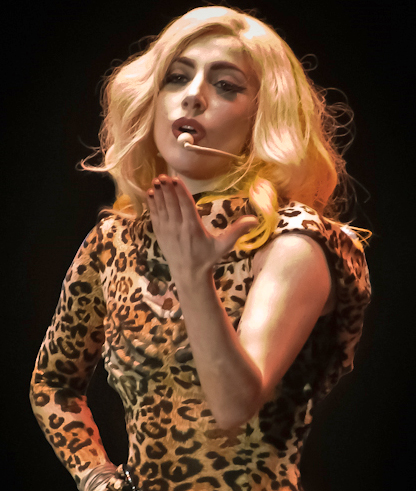
Lady Gaga: debut album, The Fame, 2008.
Lady Gaga's Meat Dress
Lady Gaga has recently discussed her issues with bulimia and calls for an end to "the diet wars."
As you watch "Born This Way" (2011), also pay attention to the messages and images. In what ways are they feminist? Strange? Complex? Confusing?
Two interesting applications of feminist theories to Lady Gaga as a performer, and this video in particular:
Judith Butler: concept of Performitivity: "The act that one does, the act that one performs, is, in a sense, an act that has been going on before one arrived on the scene. Hence, gender is an act which has been rehearsed, much as a script survives the particular actors who make use of it, but which requires individual actors in order to be actualized and reproduced as reality--once again" (qtd. in Felluga).
Felluga, Dino. "Modules on Butler: On Performitivity." Introductory Guide to Critical Theory. Purdue U. 6 April 2011. http://www.cla.purdue.edu/academic/engl/theory/genderandsex/modules/butlerperformativity.html
Donna Harraway: from "A Cyborg Manifesto" (1991): "I would rather be a cyborg than a goddess." Article about how new technology can bring us outside of the confines of our bodies.
And, for ten different scholarly interpretations of Lady Gaga's video "Born This Way," check out the blog Gaga Stigmata.
Finally, we must discuss the latest female musical sensation: Adele. Last weekend, she won 6 grammys, beating Lady Gaga for best album! Does she represent a new future of women in music and popular culture?
Consider her response to designer Karl Lagerfield's comments about her body...
What is Feminism? Why Feminisms?
Take a few minutes to jot down your definition of feminism. If you have no idea, please say so!
How Others Have Defined Feminism, For Better or For Worse
"I myself have never been able to find out what feminism is; I only know that people call me a feminist whenever I express sentiments that differentiate me from a doormat or a prostitute." Rebecca West, 20th Century Author
"The feminist agenda is not about equal rights for women. It is about a socialist, anti-family political movement that encourages women to leave their husbands, kill their children, practice witchcraft, destroy capitalism and become lesbians." Pat Robertson, Christian Televangelist
"Feminist politics aims to end domination, to free us to be who we are - to live lives where we love justice, where we can live in peace. Feminism is for everybody." bell hooks, feminist philosopher
"One is not born, but rather becomes, a woman." Simone de Beauvoir, French philosopher
"I'm not a feminist, but... I appreciate the right to help choose my government representatives. I enjoy the option of wearing pants or shorts if I want. I'm pleased that I was allowed to learn to read and write. It can be very convenient to control how many babies I want to have. It's awfully useful to be able to open a bank account and own property in my name. I like knowing that my husband or boyfriend cannot legally beat me. It's really swell to keep the money that I earn." poster from One Angry Girl
What Feminism Really Is
Equality for all persons, regardless of sex or gender.
The Sex-Gender Distinction
Simone de Beauvoir's famous quote from her book The Second Sex, “One is not born but becomes a woman” speaks to the difference between sex (biology) and gender (culture).
In what ways is this distinction complicated?!?
Feminism's Relationship to Patriarchy
We live in a patriarchal society--that is, a society structured around an unequal sexual division of power dominated by men.
My favorite way of understanding patriarchy is through author and scholar Allan Johnson's definition:
"A society is patriarchal to the degree that it promotes male privilege by being male dominated, male identified, and male centered. It is also organized around an obsession with control and involves as one of its key aspects the oppression of women" (Johnson 5).
Johnson, Allan. The Gender Knot: Unraveling Our Patriarchal Legacy. Philadelphia: Temple UP, 1997.
What examples do we have that patriarchy still exists?
Representation in US Congress 2011:
House:
Men 357
Women 78
Senate:
Men 33
Women 17
And how does Wisconsin represent? Since 1917, Wisconsin has had 2 female House members (2005, 1999) and 0 female Senators.
(Women in Congress)
Representation in Fortune 500 CEOs:
Currently, 12 F500 Companies are run by women.
(Fortune 500)
What are some other ways that we see Patriarchy at work?
Current Events:
Contraception Hearing, February 16, 2012
Photo from Fox News
How Has Feminism Made a Difference in America?
Many feminists chronicle the history of the movement in waves--movements that ebb and flow and overlap.
First Wave: Focus on voting rights, from the Seneca Falls Convention in 1848 and the creation of the Declaration of Sentiments to the right to vote in 1920.
Second Wave: Focus on political issues, including women in the workplace, equitable relationships, and reproductive rights. Two key phrases: "the personal is political" and "the problem with no name."
photo by Warren Leffler of a Women's Liberation March in Washington, D.C., 1970
Third Wave: 1990s-present. Focus on multiculturalism, individualism, popular culture, body issues. Sex positive. Choice feminism. Men included more explicitly. Use of social media to share feminist messages: feministing.com and jezebel.com
Postfeminism: rejects women as victims in several key ways, such as questioning date rape and not questioning pornography or sex work. tends to be heterosexist. a backlash to second wave feminism, critiquing feminism as a monolithic movement the prescribes personal behavior. Camille Paglia.
(Waves of Feminism)
Popular Music and Feminism:
Madonna: debut album, Madonna, 1983. Feminist scholar bell hooks on Madonna: "What some of us like about her is the way she deconstructs the myth of "natural" white girl beauty by exposing the extent to which it can be and is usually artificially constructed and maintained. She mocks the conventional racist defined beauty ideal even as she rigorously strives to embody it...Madonna never lets her audience forget that whatever "look" she acquires is attained by hard work--it ain't natural" (qtd. in Zeisler 86-87). Zeisler herself states that "Madonna's refusal to fess up to who and what she truly represented made her a logical, frustrating, and complex icon" (87).
Zeisler, Andi. Feminism and Pop Culture. Berkeley: Seal, 2008.
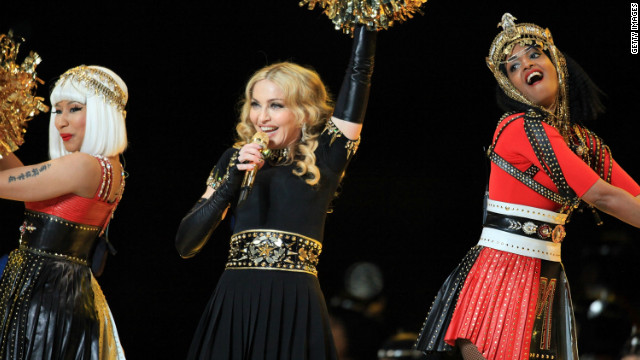 |
| Madonna performs at the 2012 Superbowl Halftime Show, image from marqueeblogs |
As you watch "Express Yourself" (1989), consider the message of the song, as well as the images in the video. In what ways are the messages and images feminist? Complex? Confusing? Strange?
Lady Gaga: debut album, The Fame, 2008.
photo of Lady Gaga from the Monster Ball Tour, 2010. photo from wikipedia,
revamped image by John Robert Charlton.
Lady Gaga's Meat Dress
Lady Gaga has recently discussed her issues with bulimia and calls for an end to "the diet wars."
As you watch "Born This Way" (2011), also pay attention to the messages and images. In what ways are they feminist? Strange? Complex? Confusing?
Two interesting applications of feminist theories to Lady Gaga as a performer, and this video in particular:
Judith Butler: concept of Performitivity: "The act that one does, the act that one performs, is, in a sense, an act that has been going on before one arrived on the scene. Hence, gender is an act which has been rehearsed, much as a script survives the particular actors who make use of it, but which requires individual actors in order to be actualized and reproduced as reality--once again" (qtd. in Felluga).
Felluga, Dino. "Modules on Butler: On Performitivity." Introductory Guide to Critical Theory. Purdue U. 6 April 2011. http://www.cla.purdue.edu/academic/engl/theory/genderandsex/modules/butlerperformativity.html
Donna Harraway: from "A Cyborg Manifesto" (1991): "I would rather be a cyborg than a goddess." Article about how new technology can bring us outside of the confines of our bodies.
And, for ten different scholarly interpretations of Lady Gaga's video "Born This Way," check out the blog Gaga Stigmata.
Finally, we must discuss the latest female musical sensation: Adele. Last weekend, she won 6 grammys, beating Lady Gaga for best album! Does she represent a new future of women in music and popular culture?
Consider her response to designer Karl Lagerfield's comments about her body...
 |
| Adele, with her 6 grammys, image from the washington examiner website, attributed to Getty Images. |
Thursday, April 7, 2011
Tuesday, April 27, 2010
eng 290: american ex-pat writers, part two
As we discussed last week, the two main waves of American ex-pat writers in Paris visited in the twenties and in the fifties. One important note is that some of the most famous Paris-inspired writing from the Lost Generation was actually published much later. Hemingway's A Moveable Feast, a memoir of his time in Paris in the twenties, was, according to Adam Gopnik, "the ultimate fifties echo of the Paris twenties" (xxiii). An interesting publishing note: A Moveable Feast was "published posthumously in 1964" (Gopnik xxiii). When Hemingway died (he committed suicide), he didn't consider the book finished. Motoko Rich explains that "[Hemingway's first wife, Mary] created a final chapter that dealt with the dissolution of Hemingway’s first marriage and the beginning of his relationship with Pauline, building some of it from parts of the book he had indicated he did not want included" (Rich). This newest edition is an attempt to restore the book more in line with Hemingway's wishes. Whichever version we read, this is a remininiscence about earlier days, an attempt to capture the Parisian moment of the twenties from tha vantage point of the fifties and sixties.
In the 1930s, American Jazz, and a wave of African American writers traveled to Paris. Gopnik notes that the French fascination with American jazz has endured (xxv). As for the writers, they too succumbed to the illusion that Paris offered more freedom than at home. James Baldwin, however, introduced a note of reality, and, according to Gopnik, "wrote, ruefully, about the disillusioning reality of being a black man in Paris, the good city of equality that turns out to be just as treacherous as New York" (xxvi).
Artists in Montmartre, Life Magazine, 1960
After World War II, American writers and artists once again flocked to Paris, "drawn to a city they had never seen but already knew through the writings of the generations that preceded them," as Christopher Sawyer-Laucanno notes in The Continual Pilgrimage: American Writers in Paris, 1944-1960 (3). This wave of writers was inspired by both the promise of Paris and their experience of the city through the earlier wave of writers covered in last week's blog entry (Sawyer-Laucanno 4). One of the biggest attractions was a sense of "artistic enfranchisement"—that is, writers and other artists felt accepted and even celebrated for being artists while in Paris (Sawyer-Laucanno 4). Sadly, this was not necessarily the case back in the United States.
This wave of writers, once again a diverse crowd containing the academic and "bohemian," the realist and experimental, attracted both positive and negative attention at home and abroad. Sawyer-Laucanno notes that though French graffiti declared "US Go Home," many French felt much more connected to this group of American ex-pats than there predecessors, because this wave connected more with French people and culture (6). Publications like the venerable Life magazine attempted to capture the ex-pat experience, but often wound up romanticizing or bohemianizing the artists (5).
Paris remains an important piece of American literature in the mid-late twentieth century because it "nurtured this generation immeasurably by providing an environment that encouraged the art and artists. translated into personal experience, this meant belief in the value and viability of writing, and beyond that belief in oneself as a creative person" (9). A sense of recognition and encouragement, a culture that celebrated artistic achievement and offered greater personal freedoms (especially for African American and homosexual writers)...this is Paris' gift to these artists. Their literature, in turn, is their gift to us: an insight into American literature and culture, created outside of the limiting bounds of post-war America.
William S. Burroughs, in a Paris Cafe, 1959
Writers and Artists reunite in Paris, 1959
Since the storied days of the fifties, much writing about Paris has focused on one of my favorite topics: food. Julia Child's monumental work, Mastering the Art of French Cooking, co-written with Simone Beck and Louisette Bertholle, transformed home cookery in America, and made the pleasures of the French table irrevocably part of the American consciousness. With the recent release of the film Julie and Julia, based on Julie Powell's blog project, the allure of Paris and French food has strengthened.
Works Cited
Gopnik, Adam.
Rich, Motoko.
Sawyer-Laucanno, Christopher.
In the 1930s, American Jazz, and a wave of African American writers traveled to Paris. Gopnik notes that the French fascination with American jazz has endured (xxv). As for the writers, they too succumbed to the illusion that Paris offered more freedom than at home. James Baldwin, however, introduced a note of reality, and, according to Gopnik, "wrote, ruefully, about the disillusioning reality of being a black man in Paris, the good city of equality that turns out to be just as treacherous as New York" (xxvi).
Artists in Montmartre, Life Magazine, 1960
After World War II, American writers and artists once again flocked to Paris, "drawn to a city they had never seen but already knew through the writings of the generations that preceded them," as Christopher Sawyer-Laucanno notes in The Continual Pilgrimage: American Writers in Paris, 1944-1960 (3). This wave of writers was inspired by both the promise of Paris and their experience of the city through the earlier wave of writers covered in last week's blog entry (Sawyer-Laucanno 4). One of the biggest attractions was a sense of "artistic enfranchisement"—that is, writers and other artists felt accepted and even celebrated for being artists while in Paris (Sawyer-Laucanno 4). Sadly, this was not necessarily the case back in the United States.
This wave of writers, once again a diverse crowd containing the academic and "bohemian," the realist and experimental, attracted both positive and negative attention at home and abroad. Sawyer-Laucanno notes that though French graffiti declared "US Go Home," many French felt much more connected to this group of American ex-pats than there predecessors, because this wave connected more with French people and culture (6). Publications like the venerable Life magazine attempted to capture the ex-pat experience, but often wound up romanticizing or bohemianizing the artists (5).
Paris remains an important piece of American literature in the mid-late twentieth century because it "nurtured this generation immeasurably by providing an environment that encouraged the art and artists. translated into personal experience, this meant belief in the value and viability of writing, and beyond that belief in oneself as a creative person" (9). A sense of recognition and encouragement, a culture that celebrated artistic achievement and offered greater personal freedoms (especially for African American and homosexual writers)...this is Paris' gift to these artists. Their literature, in turn, is their gift to us: an insight into American literature and culture, created outside of the limiting bounds of post-war America.
William S. Burroughs, in a Paris Cafe, 1959
Writers and Artists reunite in Paris, 1959
Since the storied days of the fifties, much writing about Paris has focused on one of my favorite topics: food. Julia Child's monumental work, Mastering the Art of French Cooking, co-written with Simone Beck and Louisette Bertholle, transformed home cookery in America, and made the pleasures of the French table irrevocably part of the American consciousness. With the recent release of the film Julie and Julia, based on Julie Powell's blog project, the allure of Paris and French food has strengthened.
Works Cited
Gopnik, Adam.
Rich, Motoko.
Sawyer-Laucanno, Christopher.
Wednesday, April 21, 2010
eng 290: american ex-pat writers, part one
In 1928, American composer George Gershwin created his famous symphonic tone poem, An American in Paris. In 1951, MGM released the musical An American in Paris, starring Gene Kelly and Leslie Carron along with Gershwin's tunes. The original music, and the later film, match the two main "waves" of American ex-patriate writers and artists who crossed the Atlantic to experience French culture.
Of course, Americans had traveled to Paris before the Lost Generation, as Ernest Hemingway and his contemporaries were called, and after the later Beat Generation, as Jack Kerouac and others of his time were called.
Today, we're going to explore the overall appeal of Europe, and Paris in particular, to American writers, and discuss some of the earlier writers to create in the City of Light.
Famous Americans Thomas Jefferson and Benjamin Franklin visited Paris in the 18th century, remarking on the "looser" mores of the French. Jefferson, especially, found French values lacking. In a letter written to Charles Bellini in September of 1785, he remarks: "Much, much inferior this [pursuit of temporary passions] to the tranquil, permanent felicity with which domestic society in America, blesses most of its inhabitant; leaving them to follow steadily those pursuits which health and reason approve, and rendering truly delicious the intervals of those pursuits" (15). At the same time, Jefferson praises "European politeness" and urges his fellow Americans to "adopt" some of these manners (15). Finally, he finds French taste in food and the various arts to be superb (15-16). Suspicious of interpersonal pleasures, but enamored of the more intellectual aspects, Jefferson's response remains a primary American reaction to French culture.
As Adam Gopnik remarks in his introduction to Americans in Paris: A Literary Anthology, Americans traveled to Paris to be happy. This pursuit of happiness generally followed one of two paths, "one essentially bourgeois, the other bohemian" (xiv). Jefferson, Henry James, and Edith Wharton clearly fall into the former category, as they sought "hatue-bourgeois civilization of comfort and pleasure and learning and formal beauty" (Gopnik xiv). In contrast, the bohemians like Bejamin Franklin, Henry Miller, and Jack Kerouac, "tried to have as much fun in Paris as [they] could" (xv). Such distinct categories, however, don't hold. Gopnik observes that Americans found themselves switching roles as their visits progressed. Either way, Paris promised both a kind of established social order and reverence for formal aesthetics, as well as a hedonist playground for exploring the pleasures of everyday life.
Paris also represented established European wisdom, in contrast to the young, "innocent" America. Paris offered history, perspective, and tradition that the still youthful America lacked. Because of French culture's emphasis on art and aesthetics, the country, and Paris in particular, was a kind of Muse for American writers and artists, according to Harry Levin (8). In discussing Henry James' novel The Ambassadors, Levin describes American culture as "an absence of storied landmarks, the lack of literary 'paraphrenalia,' the thinness of America's cultural atmosphere" juxtaposed with "the Old World's shrines and treasures and salons" (9). Europe provides context, especially for writers.
James and Wharton both lived for considerable stretches of time in Paris, and both created novels and short stories in which characters confronted the tension between Americanness and Europeanness, all against a backdrop of propriety and social mores.
After the destruction of World War I, Paris's avant-garde, bohemian streak flourished. The British Library Online Gallery devoted to American Literature in Europe, 1850-1950, explains that "The inter-war period saw the rise of Montparnasse as the hub of the city’s artistic community, its bars and cafés resounding to the pulse of “hot” jazz music and intellectual debate." Cafe culture, artistic creation, and intellectual inspiration attracted the Lost Generation writers, who saw a freedom and liveliness in Paris that was not present in American cities at the time.
The Lost Generation, a term first used by Gertrude Stein and then adopted by Ernest Hemingway, expressed the collective feelings of "doomed youth, hedonism, uncompromising creativity, and wounded—both literally and metaphorically—by the experience of war" (British Library). The British Library website offers an impressive list of the works of American Modernist writers who wrote and published in France between the World Wars.
While the writing differs--Hemingway's spare minimalist prose versus Stein's dada-esque pieces that rejected traditional aesthetics and meaning--the overarching Modernist sensibility prevailed. Modernist writers, including but limited to American ex-pats in France, sought to experiment and to "make it new," to quote poet Ezra Pound. Dealing with a world torn apart by the first World War, writers and artists played with form and content, and tried to capture the fragmented nature of reality, all the while creating a new whole. T. S. Eliot's landmark modernist poem The Wasteland winds down with these words: "The fragments I have shored against my ruins." Modernist writers wanted to put the pieces back together, but realized that they needed new ways of doing so. For the American ex-patriate writers, Paris (and in Eliot's case, London), offered more possibility for modernist play than the United States.
Sitting in cafes, visiting in Sylvia Beach's English language bookstore Shakespeare and Company, traipsing through the museums, and debating with other writers and intellectuals, the Lost Generation writers found a literary community in Paris during the period between the wars.
 Ernest Hemingway in Paris, 1924, from the John F. Kennedy Presidential Library and Museum, Boston, courtesy of wikimedia commons.
Ernest Hemingway in Paris, 1924, from the John F. Kennedy Presidential Library and Museum, Boston, courtesy of wikimedia commons. Works Cited
British Library. Online Gallery. American Literature in Europe, 1850-1950. 21 April 2010.
Gopnik, Adam. "Introduction." Americans in Paris: A Literary Anthology. Ed. Adam Gopnik.
New York: Library of America, 2004. xiii-xxxiii.
Levin, Harry. "Introduction." The Ambassadors. Henry James. NY: Penguin, 1986. 7-29.
Tuesday, February 2, 2010
love of learning talk: write your love story

Every couple has a story they tell themselves and others, their original tale of how they met.
Today, we'll discuss how to take your oral story and write it down for each other, future generations, movie executives, etc.
As I tell my English composition students, you have four questions to ask yourself when you begin writing:
1. Who is my Audience?
2. What is my Purpose?
3. What is my Persona?
4. What is my Message?
Your answers to these questions will help you decide how to write your story.
There are several writing exercises that can help you recreate the memories of your first meeting and courtship. Check out the handouts of exercises from Julia Cameron, Natalie Goldberg, and Twyla Tharp. How might you use these exercises, alone or together, to craft your story?
You'll also need to consider whether you want to write your version of the story, write one story together, or craft some kind of collaborative, back-and-forth story.
And, you'll need to decide how much of your story you want to tell. Do you want your story to be told in an essay format? Through letters? Incorporating mementos from your time together? On a blog? You have so many exciting options!
Monday, November 9, 2009
wom 203: domestic violence
Some feminist readers critique the Twilight series on the grounds of domestic abuse--they claim that Edward Cullen displays attributes that are common among men who commit acts of violence against women.
The issue of violence and romantic relationships was prominent in pop culture last spring, when Chris Brown beat Rihanna. Reactions to this situation were varied. This New York Times article discusses some disturbing fan reactions to the incident. Recently, both Chris Brown and Rihanna gave interviews to discuss the incident. Watch snippets here.
I'm curious to see what connections you see between the popularity of the Twilight series and the views of relationships it includes with issues of domestic violence. I'm also curious to see how you might connect these issues to the Chris Brown/Rihanna incident, as well as to our previous discussion of rape culture.
The issue of violence and romantic relationships was prominent in pop culture last spring, when Chris Brown beat Rihanna. Reactions to this situation were varied. This New York Times article discusses some disturbing fan reactions to the incident. Recently, both Chris Brown and Rihanna gave interviews to discuss the incident. Watch snippets here.
I'm curious to see what connections you see between the popularity of the Twilight series and the views of relationships it includes with issues of domestic violence. I'm also curious to see how you might connect these issues to the Chris Brown/Rihanna incident, as well as to our previous discussion of rape culture.
Wednesday, November 4, 2009
wom 203: reading for monday, november 9, 2009
Hi All!
For next Monday's class, I'd like you to read the first four chapters of Stephenie Meyers' draft of Midnight Sun. Of course, you can read more, but we'll talk about the first 89 pages or so.
While reading, I'd like you to consider how the story shifts when told from Edward's point of view. How do we view Edward and Bella's characters differently? How do we make sense of the relationship and the attraction between these two characters? Does Edward's behavior make more or less sense? And, how is gender constructed for both Edward and Bella?
For next Monday's class, I'd like you to read the first four chapters of Stephenie Meyers' draft of Midnight Sun. Of course, you can read more, but we'll talk about the first 89 pages or so.
While reading, I'd like you to consider how the story shifts when told from Edward's point of view. How do we view Edward and Bella's characters differently? How do we make sense of the relationship and the attraction between these two characters? Does Edward's behavior make more or less sense? And, how is gender constructed for both Edward and Bella?
Tuesday, November 3, 2009
Friday, October 30, 2009
wom 203: vampire diaries
In the wake of Twilight, teen vampire series--both textual and visual--have proliferated.
On Monday, we're going to watch an episode of The Vampire Diaries, a new series on the CW, which is based on the novels written by LJ Smith. The first trilogy was originally published in 1991, and in 2009 a related trilogy was published.
I wanted to show you the first episode in the series, but it is not currently available. Instead, we will jump into the middle of the season with episode six.
While watching, consider how the male and female characters compare to Edward and Bella. Compare the relationships, how each gender is portrayed, the scary/creepy/sexy aspects of the vampire in particular, and anything else of interest.
After class, write a one page freewrite building on a feminist comparison of the two series. We'll discuss on Wednesday, and I'll collect the freewrites.
Sunday, September 13, 2009
Wednesday, September 9, 2009
wom 203: feminism and philosophy
For a solid overview of feminist history, but particularly the history of feminist ideals and philosophy, check out the Stanford Encyclopedia of Philosophy.
Tuesday, September 8, 2009
wom 203: have we come a long way?
Here are several images and links to popular culture artifacts mentioned in the first two chapters of Feminism and Popular Culture. Enjoy!
A vintage Lysol ad
A WWII homefront propaganda poster
Rosie the Riveter
Vargas Pin Up Girls
Red-Headed Woman
Hattie McDaniel's Oscar Acceptance Speech
Mildred Pierce
I Dream of Jeannie
Splendor in the Grass
Miss America Protest in 1968
Beatlemania
"Will You Still Love Me Tomorrow?"
"Respect"
A vintage Lysol ad
A WWII homefront propaganda poster

Rosie the Riveter

Vargas Pin Up Girls
Red-Headed Woman
Hattie McDaniel's Oscar Acceptance Speech
Mildred Pierce
I Dream of Jeannie
Splendor in the Grass
Miss America Protest in 1968
Beatlemania
"Will You Still Love Me Tomorrow?"
"Respect"
Tuesday, May 12, 2009
Dr. J's Exam Week Office Hours
Wednesday, May 13, 6:00 pm-8:00 pm in the Commons (Study Night)
Thursday, May 14, 4:30 pm-6:30 pm in my office
Friday, May 15, 11:00 am-1:00ish pm in my office
Monday, May 18, 10:00 am-noon in my office
Thursday, May 14, 4:30 pm-6:30 pm in my office
Friday, May 15, 11:00 am-1:00ish pm in my office
Monday, May 18, 10:00 am-noon in my office
Tuesday, April 28, 2009
eng 278: ceremony
Shell shock. Battle Fatigue. Combat Stress Reaction. PTSD. All are names give to the psychological and physical symptoms manifested by soldiers like Tayo, who have lived through wartime battles and now must grapple with their survival.
VA resources on PTSD
VA resources on PTSD
Tuesday, March 31, 2009
classic rhetoric: making an argument
One sure-fire way to construct a solid argument is to use tools from classic rhetoric: ethos, logos, and pathos. Being able to combine all three appeals in one argument can help you create a solid argument. The following website explains all three appeals and gives some humorous examples of ethos, logos, and pathos at work:
http://www.rpi.edu/dept/llc/webclass/web/project1/group4/
Here's another website that explains ethos, logos, and pathos more thoroughly:
http://courses.durhamtech.edu/perkins/aris.html
And yet more examples!
http://www.public.asu.edu/~macalla/logosethospathos.html
http://www.rpi.edu/dept/llc/webclass/web/project1/group4/
Here's another website that explains ethos, logos, and pathos more thoroughly:
http://courses.durhamtech.edu/perkins/aris.html
And yet more examples!
http://www.public.asu.edu/~macalla/logosethospathos.html
Monday, March 30, 2009
How to Read a Poem

Emily Dickinson, circa 1846 or 1847, courtesy of Wikipedia
HOW TO READ A POEM
a love of learning talk by Jessica Lyn Van Slooten
March 31, 2009
7:00 p.m.
Hillside 204
UW-Manitowoc
in celebration of National Poetry Month
In order to figure out how to read a poem, we must first know why we are reading a poem. Are we reading for pleasure? For a special occasion? For class? Do we have to read the poem aloud--to an audience? to ourselves? Do we have to read it silently? Discuss it? Analyze it?
Tonight we're going to read several poems together, applying a variety of skills to the poems to read them successfully, and, more importantly, to enjoy reading.
Let's start by reading the Billy Collins poem "Introduction to Poetry." You may read the poem however you'd like--aloud, silently, etc. Then we'll discuss your reading process and what the poem itself tells us about reading poetry.
Now, here are a few misconceptions about reading poetry, taken from a useful handout on How to Read a Poem:
1. We should "get" a poem after one reading.
2. The poem has a secret, hidden meaning that we can uncover if we know the "code."
3. The poem can mean anything.
Why are these statements false? Who says if a reading is "right" or not? How can we begin to read a poem in order to both create meaning and pleasure?
Here are a few steps I like to take when reading poems:
1. Look at the poem:
What shape does it make on the page?
Is it a "skinny" poem? A long, breathless poem? A concrete poem with a definite shape?
Does it have more than one stanza?
How are the lines arranged?
How is the poem punctuated?
Do the last words in each line rhyme?
2. Listen to the poem:
Where do I naturally want to pause?
What kind of rhythm does the poem have?
What kind of sounds do the words make?
How does the poem feel as I say it aloud?
3. Consider the poem:
What does the title tell me about the poem?
What do I know about the poet?
When was the poem written? And where?
What is the cultural context of the poem?
What kind of literary devices are used in the poem?
4. Gauge my reaction to the poem:
How does the poem make me feel?
Do I like the poem? Why or why not?
5. Compare the poem to other texts:
How is the style different?
How is the subject treated?
Does the poem remind me of other works?
6. Offer up conditional meanings:
What do I think the poem is about?
How do I support these readings?
7. As the "How to Read a Poem" handout suggests, there comes a time to simply "embrace ambiguity" and enjoy the process of reading and the connection with the poem.
Robert Frost reading "The Road Not Taken"
Robert Creeley reading "Kore"
Allen Ginsberg reading Howl, part III and Footnote to Howl
The Bluest Eye
Today we start discussing Toni Morrison's novel The Bluest Eye in class.
Let's take a look at the Spark Notes guide to this novel:
http://www.sparknotes.com/lit/bluesteye/
It can be a good place to start if you're confused by the novel. But, it can also be limiting if you read only summaries and not the novel itself. You'll miss the artistry of the novel and the fullness of the story. And, while the analysis of the novel can be helpful, it also presents only one view of a certain passage. So use such resources thoughtfully and carefully.
Now, for some photos of Shirley Temple, that supposed icon of American girlhood, whose image entrances Pecola:
http://www.shirleytemple.com/
And a video of Shirley and Mr. Bojangles.
And some examples from the Dick and Jane readers:
http://faculty.valpo.edu/bflak/dickjane/spot.html
http://en.wikipedia.org/wiki/Dick_and_Jane
Let's take a look at the Spark Notes guide to this novel:
http://www.sparknotes.com/lit/bluesteye/
It can be a good place to start if you're confused by the novel. But, it can also be limiting if you read only summaries and not the novel itself. You'll miss the artistry of the novel and the fullness of the story. And, while the analysis of the novel can be helpful, it also presents only one view of a certain passage. So use such resources thoughtfully and carefully.
Now, for some photos of Shirley Temple, that supposed icon of American girlhood, whose image entrances Pecola:
http://www.shirleytemple.com/
And a video of Shirley and Mr. Bojangles.
And some examples from the Dick and Jane readers:
http://faculty.valpo.edu/bflak/dickjane/spot.html
http://en.wikipedia.org/wiki/Dick_and_Jane
Monday, March 9, 2009
Ecofeminist Approaches to Ruth Ozeki's *All Over Creation*
 Lady Lilith, painting by Dante Gabriel Rossetti, 1863
Ruth Ozeki’s All Over Creation and Ecofeminism
What is Ecofeminism?
Ecofeminism is the merging of ecocriticism (critical approaches that focus on environmental issues) and feminism (critical approaches that focus on women). There are many versions of ecofeminism, and each one has a slightly different twist on the subject.
Here are a few key Ecofeminist ideas:
* Much Western thought, especially Enlightenment thought, but also reaching back to Aristotle, emphasizes dualities like culture/nature, man/woman, reason/emotion, mind/body, God/man. In these dualities, the first term is privileged and then the second one is degraded. As you can see from the examples above, this leaves nature and women in a secondary position.
* The Enlightenment emphasized a Great Chain of Being, in which a hierarchy was established, with God at the top, and lesser beings falling in line afterwards.
* The Enlightenment also traded in earlier conceptions of nature as an organism to nature as a machine. This was, after all, the Age of Reason and the dawn of the Industrial Revolution when order and mechanization were revered.
* Ecofeminist scholars are reacting to the various dualities, hierarchies, and privileging of some kinds of knowing that persist long after the Enlightenment.
* Ecofeminist thought is sometimes in line with Deep Ecology, which is the belief that everything is interconnected and equal, that a change in one minute part of the ecosystem causes ripple effects elsewhere.
* Ecofeminists sometimes celebrate the identification of women with nature, and other times they distance themselves from this equation.
* Ecofeminism sees the oppression and/or degradation of nature and women to be intimately related.
Here are a few quotes from Ecofeminist scholars that illustrate these ideas:
Carol Adams: “Ecofeminism stresses relationship, not solely because it has been women’s domain, but because it is a more viable ethical framework than autonomy for transforming structures that are environmentally destructive.”
Ynestra King: “Capitalism, the preeminent culture and economics of self-interest, is homogenizing cultures and simplifying life on earth by disrupting naturally complex balances within the ecosystem...[in Western culture there is] a deep ambivalence about life itself, our own fertility and that of nonhuman nature, and a terrible confusion about our place in nature.”
Carolyn Merchant: “The image of the earth as a living organism and nurturing mother had served as a cultural constraint restricting the actions of human beings [...] As long as the earth was considered to be alive and sensitive, it could be considered a breach of human ethical behavior to carry out destructive acts against it.”
Winnie Tomm: “The view of both women and nature as raw material to be used according to the desires of others underpins exploitation of both.”
Susan Bordo: “By Descartes’s brilliant stroke, nature becamse definedby its lack of affiliation with divinity, with spirit. All that which is God-like or spiritual--freedom, will, and sentience--belong entirely and exclusively to res cognitans. All else--the earth, the heavens, animals, the human body--is merely mechanically interacting matter.”
Why use Ecofeminism to interpret literature?
Ecofeminism can help us understand how issues of nature and women are interwoven, and it can give us a new perspective on reading literature.
How does Ecofeminism apply to All Over Creation?
Ozeki’s novel is filled with symbols and images of nature and women--let’s make our own list! These symbols bring a greater depth to the novel than just an engaging plot.
Life, birth, death, passion are all prominent themes that are explored through female characters, the male characters who try to control them, and the children--both literal, figurative, and absent--that fill their lives.
Ozeki seems to be asking some big questions about these themes--what is the value of life? Who has power over life? Are some lives worth more than others? That she uses potatoes and issues of genetic modification to frame these questions places her novel squarely in the eco-lit camp. And we can make the case for this novel as a feminist statement as well--how many of the main characters are women? Who sets chains of events in motion?
Now, what particular characters, symbols, events, and/or places seem to lend themselves to an ecofeminist reading? Let’s test some Ecofeminist readings of the novel!
Here's a link to info and paintings of the Hindu Goddess Kali, who we see in Duncan's office towards the end of the reading. She's a great ecofeminist and multi-cultural symbol in the novel.
http://www.sanatansociety.org/hindu_gods_and_goddesses/kali.htm
What is Ecofeminism?
Ecofeminism is the merging of ecocriticism (critical approaches that focus on environmental issues) and feminism (critical approaches that focus on women). There are many versions of ecofeminism, and each one has a slightly different twist on the subject.
Here are a few key Ecofeminist ideas:
* Much Western thought, especially Enlightenment thought, but also reaching back to Aristotle, emphasizes dualities like culture/nature, man/woman, reason/emotion, mind/body, God/man. In these dualities, the first term is privileged and then the second one is degraded. As you can see from the examples above, this leaves nature and women in a secondary position.
* The Enlightenment emphasized a Great Chain of Being, in which a hierarchy was established, with God at the top, and lesser beings falling in line afterwards.
* The Enlightenment also traded in earlier conceptions of nature as an organism to nature as a machine. This was, after all, the Age of Reason and the dawn of the Industrial Revolution when order and mechanization were revered.
* Ecofeminist scholars are reacting to the various dualities, hierarchies, and privileging of some kinds of knowing that persist long after the Enlightenment.
* Ecofeminist thought is sometimes in line with Deep Ecology, which is the belief that everything is interconnected and equal, that a change in one minute part of the ecosystem causes ripple effects elsewhere.
* Ecofeminists sometimes celebrate the identification of women with nature, and other times they distance themselves from this equation.
* Ecofeminism sees the oppression and/or degradation of nature and women to be intimately related.
Here are a few quotes from Ecofeminist scholars that illustrate these ideas:
Carol Adams: “Ecofeminism stresses relationship, not solely because it has been women’s domain, but because it is a more viable ethical framework than autonomy for transforming structures that are environmentally destructive.”
Ynestra King: “Capitalism, the preeminent culture and economics of self-interest, is homogenizing cultures and simplifying life on earth by disrupting naturally complex balances within the ecosystem...[in Western culture there is] a deep ambivalence about life itself, our own fertility and that of nonhuman nature, and a terrible confusion about our place in nature.”
Carolyn Merchant: “The image of the earth as a living organism and nurturing mother had served as a cultural constraint restricting the actions of human beings [...] As long as the earth was considered to be alive and sensitive, it could be considered a breach of human ethical behavior to carry out destructive acts against it.”
Winnie Tomm: “The view of both women and nature as raw material to be used according to the desires of others underpins exploitation of both.”
Susan Bordo: “By Descartes’s brilliant stroke, nature becamse definedby its lack of affiliation with divinity, with spirit. All that which is God-like or spiritual--freedom, will, and sentience--belong entirely and exclusively to res cognitans. All else--the earth, the heavens, animals, the human body--is merely mechanically interacting matter.”
Why use Ecofeminism to interpret literature?
Ecofeminism can help us understand how issues of nature and women are interwoven, and it can give us a new perspective on reading literature.
How does Ecofeminism apply to All Over Creation?
Ozeki’s novel is filled with symbols and images of nature and women--let’s make our own list! These symbols bring a greater depth to the novel than just an engaging plot.
Life, birth, death, passion are all prominent themes that are explored through female characters, the male characters who try to control them, and the children--both literal, figurative, and absent--that fill their lives.
Ozeki seems to be asking some big questions about these themes--what is the value of life? Who has power over life? Are some lives worth more than others? That she uses potatoes and issues of genetic modification to frame these questions places her novel squarely in the eco-lit camp. And we can make the case for this novel as a feminist statement as well--how many of the main characters are women? Who sets chains of events in motion?
Now, what particular characters, symbols, events, and/or places seem to lend themselves to an ecofeminist reading? Let’s test some Ecofeminist readings of the novel!
Here's a link to info and paintings of the Hindu Goddess Kali, who we see in Duncan's office towards the end of the reading. She's a great ecofeminist and multi-cultural symbol in the novel.
http://www.sanatansociety.org/hindu_gods_and_goddesses/kali.htm
The painting at the top of this post is of Lilith, a powerful and mythical woman, said to be a lust-inducing demon, a chil killer, and, by some accounts, Adam's first (and rejected) wife.
Subscribe to:
Posts (Atom)